
Answers · 17 answers
Frequently asked questions
Quick answers about EvoqHR and everyday HR terms like notice period and CTC.
Read more
Why an HRMS
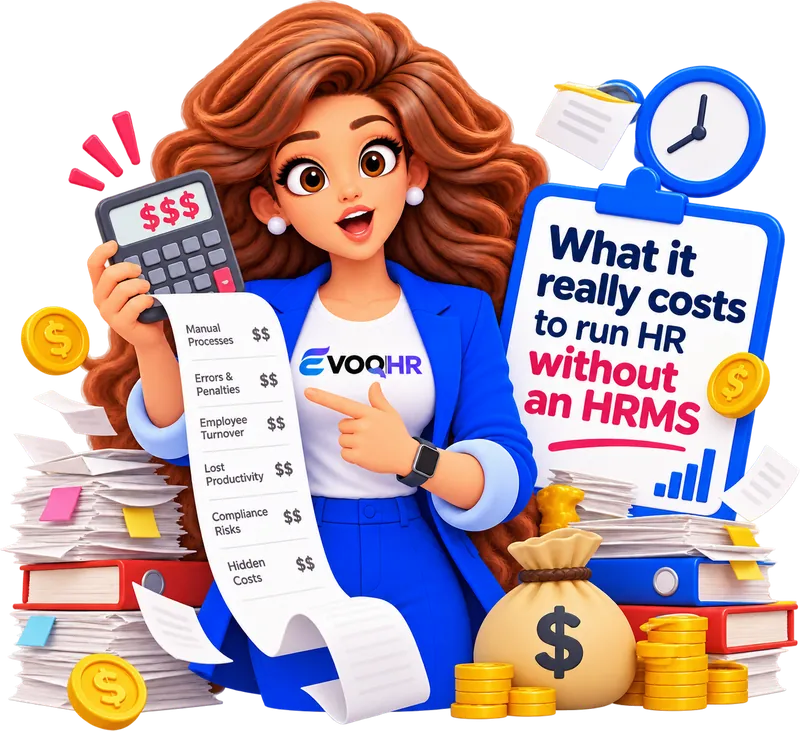
Spreadsheets and chat groups feel free. They are not. Here is where manual HR quietly costs you money, time, and good people - and how to see your own numbers.
Each one is common, quiet, and avoidable. Open a card to see what goes wrong, a real-life example, the impact, and how an HRMS fixes it.
Loss 1
Salaries are calculated from spreadsheets that mix attendance, leave, and revisions by hand, so one wrong cell flows straight into pay.
What it looks like
A joiner’s mid-month start date is entered wrongly, so payroll over-pays one person and under-pays another. Fixing it takes two days and a difficult conversation.
What it costs you
How an HRMS fixes it
Payroll reads attendance and leave directly, applies the salary structure automatically, and produces payslips employees can open themselves.
Loss 2
HR re-types the same employee data into several files, chases approvals on chat and email, and answers the same questions every week.
What it looks like
Every month-end, two people spend three days merging attendance sheets from five teams before payroll can even start.
What it costs you
How an HRMS fixes it
One employee record feeds every module, approvals run in the system, and employees self-serve for payslips and balances.
Loss 3
Paper registers and shared sheets make it easy to mis-record time, forget unpaid leave, or lose track of balances.
What it looks like
Leave balances in a sheet are two months out of date, so an employee is told they have 8 days left when they actually have 2.
What it costs you
How an HRMS fixes it
Check-in/out, shifts, policy-driven leave accrual, and approvals live in one place with a clean audit trail.
Loss 4
Statutory deductions, filings, registers, and policy acknowledgements are tracked by memory, calendars, or a few key people.
What it looks like
A due date for a statutory contribution is missed because the person who tracked it was on leave.
What it costs you
How an HRMS fixes it
Records, calculations, and approvals are kept and timestamped, so reports and proofs are a few clicks away.
Loss 5
Personal data lives in email attachments, personal drives, and chat groups - copied, forwarded, and impossible to control.
What it looks like
An employee’s bank details and ID proofs are sent over a messaging app and sit on three personal phones.
What it costs you
How an HRMS fixes it
Role-based permissions, tenant-isolated storage, and audited access keep sensitive data in one controlled place.
Loss 6
Resumes, interview notes, and offers are scattered, and onboarding depends on someone remembering every step.
What it looks like
A strong candidate accepts another offer while feedback is stuck in a manager’s inbox.
What it costs you
How an HRMS fixes it
A single pipeline for openings and candidates, with a structured onboarding flow that creates the employee record once.
Loss 7
Employees who cannot see their payslips, balances, or request status, or who wait days for simple answers, feel ignored.
What it looks like
A talented employee leaves after repeatedly chasing HR for a reimbursement and an experience letter.
What it costs you
How an HRMS fixes it
Self-service, quick approvals, and transparent records give people the experience they expect at work.
Loss 8
Leaders ask for headcount, attrition, absenteeism, or payroll cost and HR needs days to assemble the answer from several files.
What it looks like
Budget planning relies on an out-of-date headcount sheet, so the hiring plan is wrong from the start.
What it costs you
How an HRMS fixes it
Dashboards and reports are built from the same live records, so questions get answered in minutes.
Loss 9
Approvals, policy changes, and employee requests happen over chat and calls, so there is no reliable record when someone disagrees.
What it looks like
A manager says they approved leave verbally; the employee says they were never told. There is no record either way.
What it costs you
How an HRMS fixes it
Every request, approval, and change is recorded with who did what and when.
Tick everything that sounds like your team to see your level of exposure.
0/10
Tick what applies to you
Move the sliders to match your company. The estimate updates instantly.
Attendance, leave, payroll prep, data entry, and answering routine questions.
Share of total payroll affected by over-payments, missed deductions, and corrections.
Share of employees who leave partly because of a poor HR experience.
As a share of their annual salary: hiring, onboarding, and lost output.
Estimated yearly cost of manual HR
$82,855
about $6,905 every month
An illustration based only on the figures you set above - not a quote or a guarantee. Your real numbers will differ.
Small teams feel the pain differently, not less. With 20 people, one wrong payslip or one lost leave record is personal and visible. An HRMS keeps the basics right from day one, so the process does not break as you grow.
Spreadsheets are flexible, but they have no approvals, no access control, no audit trail, and they depend on one person’s accuracy. The risk grows with every employee and every manual formula.
Add up the hours your team spends each month on attendance, leave, payroll, and data entry and multiply by their hourly cost; add the cost of payroll mistakes and the cost of avoidable exits. The calculator on this page does it with figures you can change.
No. It removes repetitive admin so the team can focus on hiring, culture, employee relations, and advising managers - the work only people can do.
Creating your organisation takes minutes. Most teams then import or add employees, set their leave and attendance policies, and run a first payroll within a few weeks, depending on size and how organised their data already is.
A good HRMS is usually safer than files on laptops and chat apps: access is limited by role, activity is logged, and data is stored in one controlled place. EvoqHR keeps each organisation’s data isolated from others.
More to read, picked for the topics on this page.
Answers · 17 answers
Quick answers about EvoqHR and everyday HR terms like notice period and CTC.
Read moreAnswers · 28 answers
Plain-language answers on pay, leave, working hours, safety, and leaving a job.
Read moreGuide · 5 min read
The core responsibilities of an HR team - people, policy, compliance, and culture - and the habits that make HR trusted rather than feared.
Read moreSet up your organisation in minutes and bring attendance, leave, payroll, and records into one place.